Manuscripts
Common Mistakes in Transcribing Old Handwriting and How to Avoid Them
Every transcription begins with a small act of faith: that the marks on this page mean something and that you can recover it. Then comes the first misreading — a name that turns out to be two words, a date that was never a date — and the faith becomes work. Most errors in old handwriting are not mysterious. They cluster in a handful of predictable places, and they can be caught by habits rather than talent.
The eye finishes what the hand left unfinished
Reading is not passive. Your brain predicts, and when the strokes are ambiguous it quietly fills the gap with a familiar word. This is where most beginner errors begin.
Medieval and early modern scribes worked with a small repertoire of strokes. The letters i, n, m and u are all built from the same short vertical minim, distinguished mainly by how many there are and where the pen changes direction. A dense cluster of them can plausibly be read several ways.
- Minims. Count them. Then count again, and check whether the word makes sense in the sentence.
- Long s (ſ) and f. The long s carries only a small nub on the left; the f has a full crossbar through the stem.
- c and t. Look for the crossbar of the t; without it, you may be reading a c.
- e and o. The eye of the loop and the position of the pen's exit stroke usually settle it.
- rn and m. Two letters drawn close together can masquerade as one.
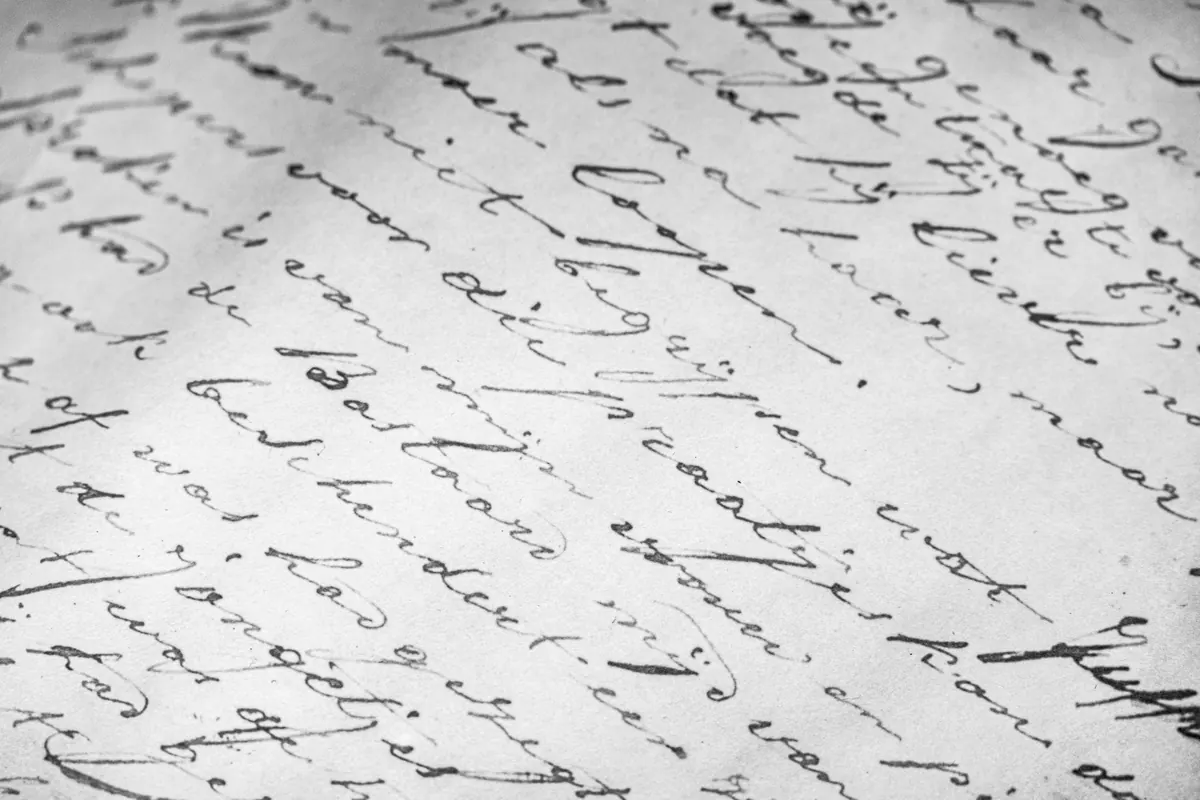
A useful first step on any new document: find a clear, well-lit page and build your own alphabet sheet from that scribe's hand. Copy the forms of the letters you find difficult, note the date and the folio, and keep it beside you. One scribe's c is not another's.
Abbreviations expanded too quickly
Older documents are full of contraction, and contraction is where confident beginners go wrong. A tilde or wavy line over a vowel usually signals a missing m or n. A stroke through the descender of a p commonly stands for per, pro or prae. Superscript letters signal that the rest of the word has been dropped. Whole words, such as et or the ending -que, often have signs of their own.
The mistake is not expanding an abbreviation; it is expanding it silently and then forgetting it was ever a guess. Record what you supplied. Brackets are the simplest convention — p[er], d[omi]no — and a reader can then see exactly where you intervened. Build a short abbreviation table for each document as you go, and resist the urge to assume that a sign means the same thing across two different archives, or even two different scribes in the same register.
Silent modernisation
It is tempting to tidy: to change u to v, to add capitals, to correct spelling, to insert punctuation where the original has none. Each of those choices destroys evidence. The way a word was spelled may tell you about the writer's education, their region, or the date of the document.
Transcribe what is on the page, including doubled consonants, unexpected capitals and the absence of punctuation. If you decide to normalise anything — and sometimes a clear editorial policy is the right call — state the policy at the top of the file and apply it without exception. The same rule applies to place names: a modern form in the margin is helpful, a modern form substituted in the text is not.
Losing the thread of the page
Two opposite slips are common. The eye skips back and a word or phrase is written twice; or the eye jumps forward and a line disappears entirely, especially where two consecutive lines begin or end with the same word. Long lists of names and accounts are particularly vulnerable, because the rhythm of repetition invites skipping.
Slow down and work line by line. A sheet of paper or a ruler under the line being read keeps the eye anchored. Number the lines lightly in your draft if the document is difficult, and at the end of each page count your lines against the original. Take a real break every twenty or thirty minutes; fatigue produces exactly these two errors.
Names, numbers and dates deserve a second look
Proper nouns and figures carry the most weight and receive the least scrutiny. Roman numerals are easily misread at the tail end of a sequence, where a final i may be drawn with a flourish or as a j. Sums of money, weights and measures may use symbols that no longer mean what they look like. Dates may be given as feast days rather than calendar days, and in some places the year did not begin on 1 January.
When something does not add up, flag it rather than fixing it. Check the same name elsewhere in the document: a scribe who writes a surname one way on folio 3 will usually be consistent, and the comparison often resolves the doubt. Keep variant spellings of names as they appear and reconcile them in an index, never in the text.
Uncertainty that leaves no trace
The most damaging error is not a wrong letter. It is a confident reading that gives no sign it was ever in doubt. Six months later, neither you nor anyone else can tell which words were certain and which were inferred.
Agree on conventions before you start and write them at the top of the file: square brackets for supplied letters, a question mark in brackets for a doubtful reading, a clear phrase for an illegible passage, three dots for a gap in the manuscript. Then keep a separate list of doubts — folio, line, the reading you chose, and what the alternatives were. Keep your notes in a different file from the transcription, so that the clean text does not quietly absorb your guesses.
A verification routine that catches the usual errors
Checking is a skill of its own, and it works best as a fixed sequence rather than a vague intention to look again.
- Transcribe the page without looking back, then compare it with the image only when you have finished.
- Read from the original to your text, not the other way round. Follow the source with a finger or cursor and check that each word has been recorded.
- Re-read a paragraph backwards, word by word. Meaning stops helping you and missing words become visible.
- Read the passage aloud. Hesitation usually marks a place where your eye and your hand disagreed.
- Check every proper noun, number and date a second time, in isolation from the sentence.
- Leave the page overnight and read it cold. The errors you could not see yesterday are often obvious by morning.
- Ask someone else to check a single page. They have no memory of your decisions and will see what you cannot.
- Note the exact shelfmark, folio and recto or verso at the top of every file, so that a later check is possible at all.
Keep a notebook of your own mistakes
After a few documents, patterns appear. One transcriber consistently drops the final -e; another reads every abbreviation as per. Write these tendencies down, along with the letter forms and contractions that gave you trouble, and review the list before starting a new manuscript. It is a small habit and an unglamorous one, and it will improve your accuracy faster than any amount of rereading.
Transcription rewards patience more than speed. When in doubt, describe the doubt in the margin and move on; a page finished honestly, with its uncertainties visible, is worth more than a page that reads smoothly and cannot be trusted.
Photo: Magda Ehlers / Pexels
Related Articles