Archives
How to Date an Undated Local Document: 7 Clues in Paper, Ink, and Handwriting
The folder said 1780–1820, and nobody had opened it since the 1930s. Inside were fourteen leaves of a household account, unsigned, unnumbered, and without a single year written anywhere on them. Every archive has a folder like this: the document is legible, sometimes even interesting, but it floats free of time, and the catalog entry offers only “s.d.” — sine die, without a date. You do not need a laboratory to pull it back toward a decade. You need a good lamp, a magnifier, a ruler, and the habit of reading objects as evidence rather than decoration.
1. Paper: Watermarks, Chain Lines, and the Mould
Paper is often the most datable thing in the folder, because sheets were made in batches and the mould left its fingerprints on every one. Hold a leaf up to a light. Laid paper shows closely spaced parallel lines crossed at intervals by heavier chain lines — the wire of the mould. Wove paper shows an even surface with no chain lines at all; it was developed in England around the middle of the eighteenth century and spread across Europe over the following decades. A wove sheet inside a file of 1750s correspondence should make you suspicious of the folder, not the sheet.
Watermarks sit near the middle of the sheet or in a corner: initials, a mill name, a figure, sometimes a date. A dated watermark gives you a fixed point, but only in one direction. The paper cannot be older than the year in the mark. It can be considerably younger, since paper sat in storerooms for years. Look also at the sheet itself: handmade paper is slightly uneven in thickness and often has deckled edges, while machine-made paper from the nineteenth century onward is uniform and arrives in continuous webs.
2. Format, Ruling, and Printed Furniture
Measure the sheet and work out how it was folded. A folio is folded once, a quarto twice, an octavo three times. Account books, letters, and legal copies each had their own habitual formats, and a format that seems old-fashioned for its content is worth noting. Then look at the lines. Lines ruled by hand with a plummet fade to gray and often stop short of the margin; machine-ruled and printed forms belong to a later, more commercial world.
Printed furniture dates quickly. Blank sheets give way to printed letterheads with the firm’s name, then to letterheads crowded with telegraphic codes and later telephone numbers. Printed forms with boxes to fill in, embossed stamps, revenue stamps, and pre-printed receipt numbers are all useful. So is the presence of an envelope: letters were normally folded and sealed as their own wrapper until envelopes became cheap and common in the nineteenth century.
3. Ink, Nib, and the Marks of the Tool
Iron gall ink, the workhorse of European documents for centuries, browns with age and can burn through the paper along the strokes — a condition usually called ink corrosion. That browning tells you the ink is old, not exactly how old. More useful is the character of the line. A quill or a soft steel nib gives a flexible stroke that swells under pressure; a modern steel pen is more even; a ballpoint leaves a uniform, slightly greasy line and often a faint groove; a typewriter leaves perfectly regular characters with a characteristic ribbon texture, and a carbon copy has its own flat, bruised look.
Colour helps within a broad range. Blue-black inks and aniline dyes belong mostly to the later nineteenth century and after. Purple or violet text from a hectograph or spirit duplicator is a twentieth-century signature. Rubber stamps, with their smudged edges and pad texture, are a strong sign of modern office practice. So is pencil used as a working tool rather than for a rough draft.
4. Handwriting: Letterforms, Slant, and Speed
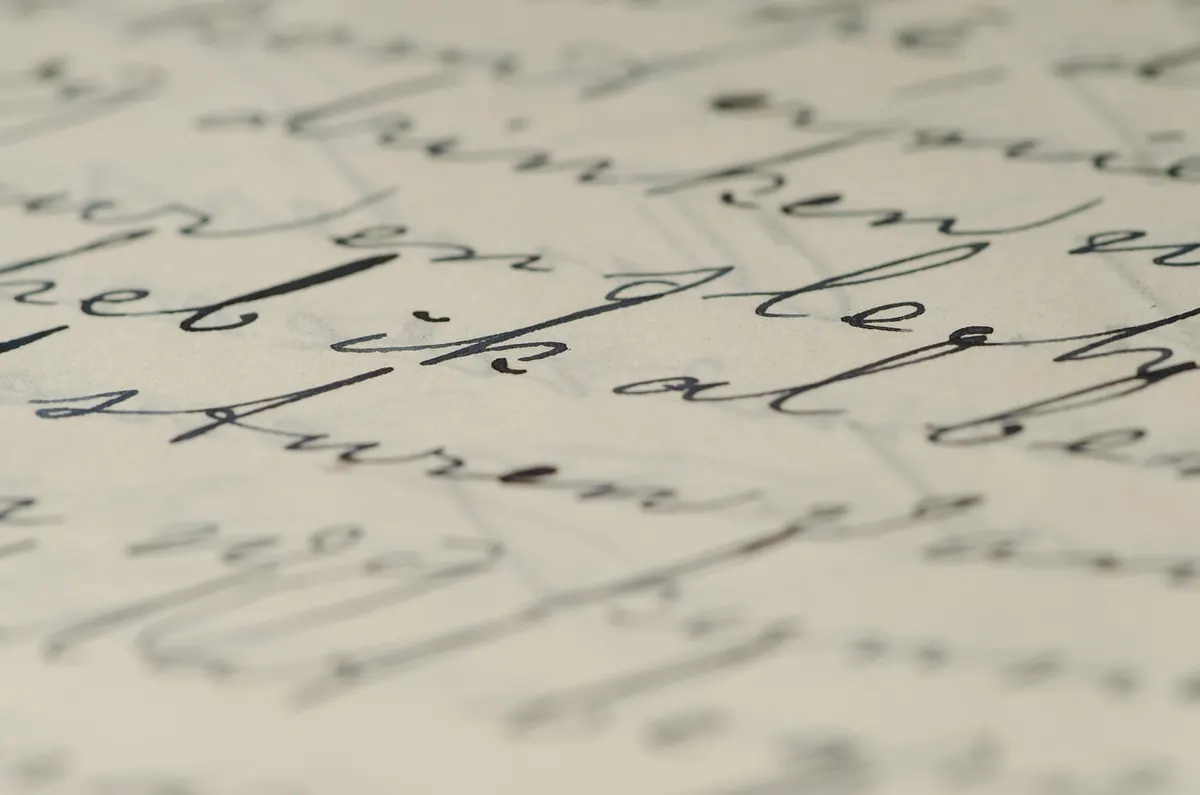
Paleography rewards attention to a few features that changed on a schedule. Look at the letters that fell out of use: the long s (ſ), the old abbreviations with a tilde or a superscript letter, and the ornate capitals of chancery hands. These disappear from formal writing at different moments in different places, so treat them as regional evidence rather than universal rules.
What to compare
- Slant and speed. A slow, upright hand with separate letters suggests a formal or older writer; a rapid sloping hand with linked letters suggests a practiced, later one.
- Ascenders and loops. Looped, flourished ascenders and heavy shading belong to the nineteenth-century taste for ornamental penmanship.
- Numerals. Superscript ordinals, long-tailed sevens, and open fours are period markers worth collecting from dated documents in the same hand.
- Abbreviations and titles. Ill.mo, Sig., Dott., and reverential formulas change with administrative fashion.
- The same hand elsewhere. If you can find the scribe in a dated document, you have dated the writer, not the paper — and that is often enough.
5. The Document’s Own Words
Read the text as a list of small anachronisms waiting to be caught. Institutions, currencies, and address conventions are the most reliable. A document that mentions lire, soldi, and denari belongs to a different world from one that mentions Italian lire after unification, and a price in euros places you firmly after 2002. Regnal years, indictions, and feast-day dating (“li 15 di agosto”) tell you what calendar the writer had in mind. So do titles of offices, names of provinces and districts, and the numbering of streets and houses, which was reformed at different times in different towns.
Later details are even easier. Postal codes, multi-digit telephone numbers, typewritten reference lines, and the names of modern ministries all narrow the window sharply from the far end. None of these tells you the exact year, but each one sets a fence.
6. Fasteners, Folds, and the Wear of the File
Turn the bundle over and look at the damage. Straight pins leave small paired holes and rust halos; brass paper fasteners, staplers, and paper clips arrive in the late nineteenth and early twentieth centuries and each leaves its own scar. Linen thread stitching, sealing wax, and docketing endorsements written across the fold in a bored official hand all carry dating weight. Folds matter too: a letter folded into a narrow strip for delivery was handled differently from one filed flat in a registry.
Then read the endorsements. Archival stamps, shelfmarks, and tidy pencil numbers on the verso were usually added when the file was organized, which gives you the date by which the document already existed in this archive. That is a hard ceiling, and a useful one.
7. Neighbors: Cross-Dating in the Same Folder
Finally, use the company the document keeps. Papers were bundled for a reason, and the dated items around an undated one often share a scribe, a watermark batch, a subject, or a dispute. Check the notarial protocol, the parish register, or the correspondence that mentions the same people. A marriage, a death, or a change of office can fix a name to a year and pull the whole bundle with it.
Before You Write a Date on the Folder
Work in a fixed order: photograph the document, record measurements and watermark positions, transcribe the text, then list your evidence in two columns — what pushes the date earlier and what pushes it later. Settle on a bracket rather than a single year, and say what set each end. “Circa 1790–1810, on the evidence of wove paper and the hand of the same scribe as the 1804 receipts” is honest and useful; “1797” is a guess wearing a costume.
Write your note on a separate slip or in the catalog record, never on the document itself. Soft pencil on a slip can be erased; pencil on a folio cannot be undone without a conservator. And if the document is fragile, mold-damaged, or heavily corroded by ink, stop handling it and ask a conservator before you do anything else.
Photo: Andrys / Pixabay
Related Articles